That’s Bananas!
By Katie Eveleth
“I can’t find my phone.” Hallie stated as she was remaking her bed for the night, unaware that she was about to be interviewed. It was a cold night in our Dellplain suite, one reason being that it was snowing outside and the second reason is that the school refuses to fix our heaters. The ongoing fight with FIX-IT, Syracuse University’s maintenance group, is far from over but there are more pressing topics to hear about from Hallie.
Hallie is a junior at Syracuse University, studying nutrition and psychology. When she is at home, in nearby Westchester New York, she enjoys taking her mini schnauzer dog on walks but when she is at school, she frequently spends her free time playing tennis and completing paint by number drawings. Her typical morning consists of “waking up at 8:30am to get ready for school, eat breakfast and study.” As her roommate, I cannot confirm the reliability of this statement, seeing as I have never witnessed her waking up at 8:30am. Nevertheless, she continues to describe her day to me, “after school, I work for two hours, do homework and go to sleep.” Hallie works as a babysitter for a family in the area and she also has an internship at a food research lab as a required aspect of her major. Hallie is currently living with two roommates, myself and Jia, to soon be followed by a third roommate, Valentina, who is abroad in South Korea at the moment. Hallie says she has been living “with Katie for the past three years at Syracuse,” we were freshmen year roommates and “Jia was our friend freshman year who didn’t come back last year [due to COVID-19] but now that she’s on campus again, we all decided to live together.”
To find out more about Hallie’s life from another point of view, I met with Jia separately. Jia describes Hallie as the perfect roommate. Jia excitedly explains that “this living situation with Hallie and Katie is so great that nothing could top this trio.” When it all seems that their living situation is so incredible that it is unmatched by any other possible arrangement, Jia reveals something disturbing about Hallie. Before agreeing to live with Katie and Hallie this year, one night over this past summer, Jia received an unexpected phone call from an unidentified caller located in the middle of the woods. The caller disclosed themselves to be Katie, myself, calling to warn Jia of this strange phenomenon in Hallie’s life.
Everyday Hallie eats multiple meals just like anyone else would. Her favorite food “is bananas because they are a super easy snack to have on the go,” and they are also a “very healthy and delicious treat” that can be prepared in many different ways. Bananas are a likeable fruit because they can be so versatile and easy. They can be “eaten plain or mixed into something else.” Since we still live in a dorm suite with no kitchen, it can be difficult to make our own food, but Hallie finds ways to be creative. The most common dish that Hallie puts together is oatmeal with peanut butter, bananas and if she is feeling fancy, she will throw in a few strawberries. Additionally, she will add bananas to rice cakes or crackers. She also appreciates finding a good banana and peanut butter smoothie when out grocery shopping. She does not appreciate any type of banana dishes concocted as an experiment in the dark kitchen of Ernie Davis Dining Hall. This is a widely agreeable opinion since no one trusts the fruit at Ernie, it is simply “too scary.” Unfortunately the quality of the food at Ernie Davis is the reason that Hallie needs to figure out how to create her own meals despite the lack of basic kitchen appliances and utensils. If Hallie had a kitchen, she would be able to “make more reasonable meals” and she loves to “bake desserts, especially banana bread.” Clearly, bananas are a staple in most of Hallie’s preferred dishes at school and at home.
There is one detail that has been left out from the information about Hallie’s daily meals. The one peculiar element in Hallie’s diet that has upset the balance of her living situation with her roommates. It is a small feature for Hallie but it severely impacts the well-being of her roommates. Hallie has always had a unique liking towards bananas but they are not ordinary bananas; Hallie only eats bananas after they have turned brown and black.
To find out why Hallie eats brown bananas, I questioned her on how it all started. Last year, Hallie started to buy her own groceries for her dorm. This was when she began to notice that all of her “bananas were turning black very quickly” and she didn’t have enough time to eat them before they went bad. One day she saw something about how to preserve bananas for a longer period of time. Although she doesn’t remember where she found this information, she considers it a reliable source. Basically, the information noted that if people wrap their bananas in clear wrap and then store them in the refrigerator, the bananas may last longer. Hallie started doing this ritual with the bananas that she bought and she “has not gone back to the old way,” it has “been a life changing discovery for the better.”
As Hallie’s roommate, I remember the first day I witnessed her wrapping the bananas, because this was a life changing discovery for me as well, but for the worse. I vividly recall seeing her place the fresh yellow bananas into the refrigerator after she wrapped them. I told her it was weird to put bananas in a refrigerator but she said that they would last longer like this. Normally a banana that is in open air can stay yellow with few spots for almost a week. In just two days, the former yellow bananas had turned completely black. I was shocked and disgusted. The smell of rotten bananas was so potent, I couldn’t begin to imagine Hallie eating those bananas. Somehow she looked past the appalling smell of bananas and ate it with peanut butter and rice cakes, her usual meal. I felt sick and left the room.
When discussing Jia's thoughts and feelings towards the banana situation, she admitted something similar while tearing up. Jia was aware of the banana situation before living with Hallie due to the warning from myself but she couldn’t envision the magnitude of the problem. Once Jia witnessed the reality, she acknowledged that this habit of eating black bananas is very strange. Everyday, Jia feels it is necessary to clean the table in the common room. She is a very clean and organized person, similar to Hallie. At one point, Hallie was rushing out of the dorm for a class she was late for and she left the banana peel on the table. As usual, Jia went to clean the table and said that the feeling of “the banana peel was so slimy and gross” that she feels “sort of put off by bananas now.” The trauma of touching the black banana peel was so significant that she “might not be able to eat bananas again.” This conclusion may seem a little extreme but it is a thought that cannot be fully understood unless one has encountered a banana in this state.
Intrigued about how the black banana habit has been treated at home, I spoke with Hallie’s older sister, Christine. Christine looked shocked to discover that Hallie eats bananas when they are black. She claims she has “never seen Hallie eat bananas in that strange way.” According to Christine, Hallie only eats yellow bananas at home. I was not anticipating this reaction from Hallie’s family. To confirm what Christine said, I conferred with Hallie again. Why would Hallie eat yellow bananas at home and black bananas at school? What is so different about these environments that they have such different outcomes of how Hallie eats bananas? Is there social pressure to eat bananas normally at home versus at school?
At first, Hallie responded saying that she believes eating black bananas is “just a phase while [she’s] in college.” Quickly after reconsidering what she had just said, she withdrew the statement saying that “actually it is not a phase” because she “doesn’t like to waste money” and wants to “make the most out of the bananas purchased.” At home, her family eats bananas as well so there is no need in trying to preserve them for longer periods of time. At school, only Hallie eats bananas but she has noticed the influence of her banana habits on her roommates. Hallie admits that her roommates seem to dislike her banana habits and that “Katie, in particular, seems to be very offended by them.” The black bananas seem to be a constant “point of bullying” or passive aggressive joking from Hallie’s roommates but she understands their concern. Hallie confesses that bananas “don’t taste as great when they’re black” as opposed to when they are “perfectly ripe, but black bananas are still edible.” When peeling a black banana, the insides “are just a little mushy but it is still normal colored inside.” This is the main point of the controversy between Hallie and her roommates. Her roommates do not fall for the delusion of seeing the inside of the black bananas as normal colored since they are coated in a layer of brown slime.
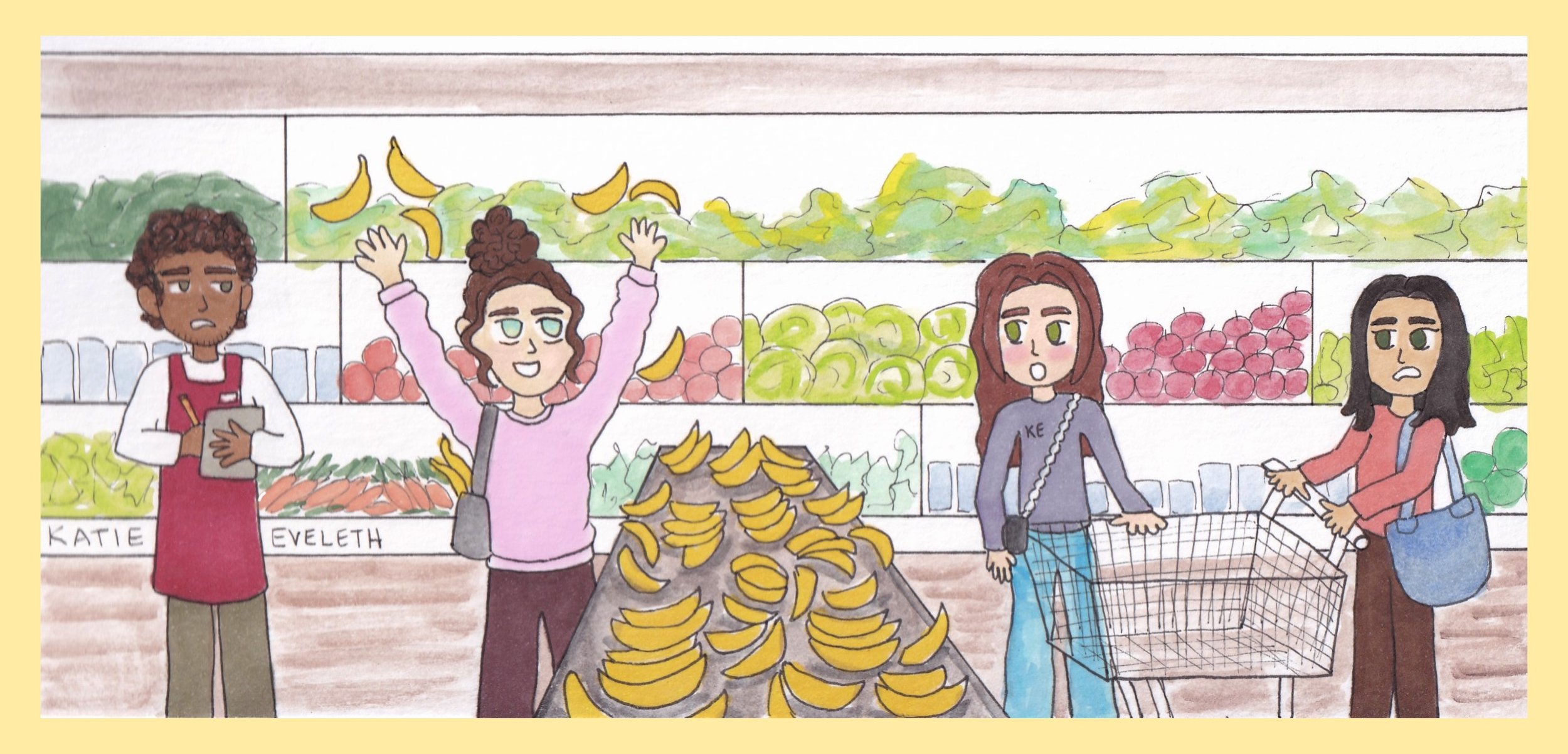
On Sunday mornings, Hallie visits the local Wegmans, a grocery store chain in upstate New York. I accompanied Hallie on her weekly trip to Wegmans to observe the process. Knowing that she might not have time to grocery shop again for a whole week, Hallie purchases every single banana that Wegmans has to offer. Bananas are a staple of Hallie’s daily diet and there aren't any meals that do not include bananas that Hallie can easily make in the dorm. Hallie doesn’t mind the fact that the bananas will turn black as long as she is able to have enough bananas for the week. While placing bags of bananas in the cart, a Wegmans employee recognizes Hallie. He laughs and greets her as they usually do. He says that he knows her as “the girl who buys all the bananas on the shelf.” After Hallie leaves Wegmans, he says that it is his job to restock the shelves with bananas from the back room so other customers have a selection of bananas to pick from.
Despite strange interactions with grocery store employees and harsh reactions from her roommates, Hallie stands strong. Hallie will continue to disregard the critics and eat black bananas because they are still ok to eat, even though eating black bananas is not widely accepted by our society today.
(Note: the names and details of my friends have been changed for anonymity from banana critics.)